Liel Maghen: Dialogue is not about pretending symmetry. It is about acknowledging pain and creating a shared future
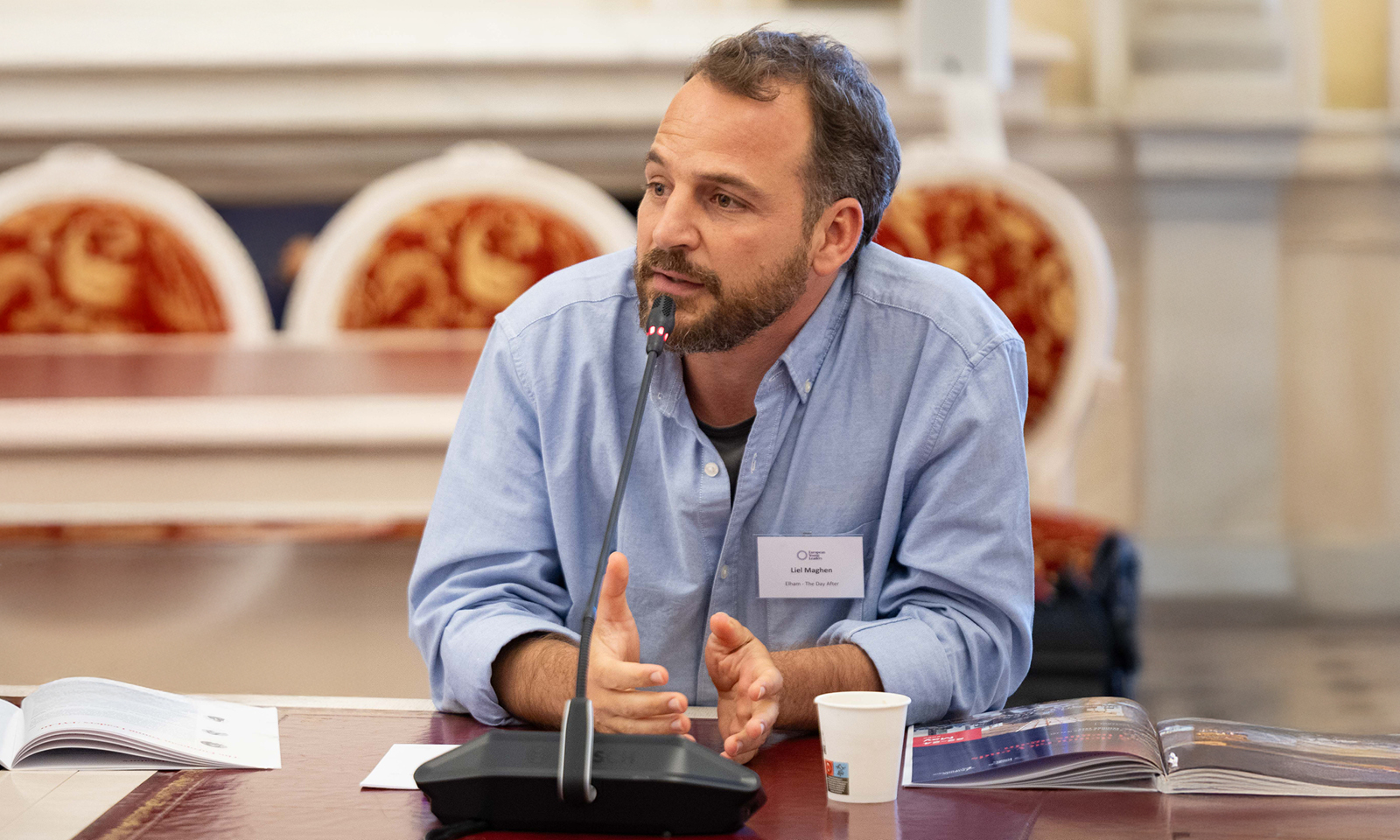
„The situation is brutally asymmetrical – characterized by systemic oppression, military occupation and daily violence against Palestinians. Any dialogue ignoring this reality would not only be wrong – it would make us complicit. I am the grandson of Holocaust survivors and I lost friends on 7 October. And yet, none of this can justify what is happening in Gaza. I am desperate. I am ashamed. The international community must act immediately to stop this,“ says peace activist Liel Maghen. We spoke to him about his activities to build dialogue and a vision for a shared future, even in a time of genocidal war. „In this unbearable situation, I’m still looking for dialogue with Palestinian men and women – not because I think everything is fine, but because it’s not. Dialogue is not about erasing differences or pretending symmetry. It is about facing reality together, acknowledging pain, resisting polarisation and creating a future in which shared humanity outweighs inherited trauma and political identity,“ he adds.
How did you get into activism for peace?
I guess it’s kind of in my birth certificate. Although I grew up in Israel, I heard Arabic at home, as my father is from Libya. In Israel, however, Arabic was often seen as the language of the enemy. This contradiction affected me deeply. I felt a strong need to bridge this gap, especially as I also had to deal with the intergenerational trauma of my father being driven from his home.
So your background was a big influence in choosing what you do?
Definitely. Growing up in between different cultural backgrounds, so to speak, does take a toll on a person. Plus, my mother is from Italy, so you can probably imagine how people from Europe and North Africa think about their backgrounds. Specifically in the case of Italy and Libya, even with a colonial past. Our household was full of European prejudices against North Africa and full of African views of white Europeans. It was a constant conflict that eventually led to my parents‘ divorce.
That sounds quite personal. We don’t have to publish that part if you don’t want to.
That’s cool. What I’m saying is that I was able to see live how the logic of collective division translates into interpersonal relationships. How identities, disagreements and conflicts are reproduced. I was exposed to language like these Libyans, they are such barbarians, they have a backward culture. My father, on the other hand, used to say that European Jews never really accepted him. But on the other hand, he referred to the Arabs as even worse barbarians.
How did you feel about that?
I was caught in the crossfire as a kid, but it taught me to see things from more than one angle. The multiplicity of perspectives is something I have adopted, I carry it with me, it has become part of my life. I don’t have to choose, I can have two truths at the same time.
So somewhere in here a peace activist was born?
It’s more complicated than that – my parents‘ story is just one part of a larger intergenerational struggle to find my place.
My maternal grandparents survived the Holocaust and chose to stay in their hometown, Rome, despite being persecuted there before. So there was also this Jewish historical trauma in my family background.
My paternal grandparents were expelled from Libya, and they came to Italy as refugees. My father eventually integrated into Italian society and became active in supporting other Jewish migrants – first from North Africa and later from the former Soviet Union – helping them to get to Italy and from there to Israel. It was during this period that my parents met and began their relationship.
But you were born in Tel Aviv, weren’t you?
Yes, my parents decided to move to Israel after their wedding in Rome. They were driven by a desire to raise their family in a safer and more stable environment – especially after the violent attack on the Great Synagogue in Rome in 1982. This event affected them deeply and reinforced their conviction that Jews could not rely entirely on Europe for security.
They were right-wing, nationalist and Zionist in their worldview. Moving to Israel was not only a practical decision, but also an ideological one. They wanted to live in Jewish society, surrounded by their own people, in a place they believed could provide them with both identity and protection.
It is also important to recall the political climate in Italy in the 1980s. At that time, there was a strong wave of public solidarity with Palestine. In families like mine, this often deepened the sense of alienation and reinforced nationalist convictions.
Do you see parallels with the current situation? Even today, many Jews around the world feel threatened by a movement that opposes Israel’s policies.
You know what, I see both a parallel and a paradox there. A few of my friends have moved away from Israel because they disagree with the government, they organize demonstrations against it, and so on. And then they come to Europe where they are boycotted or attacked because they are from Israel. It’s bizarre, but their processing of these events is very defensive.
I have a friend who was a leftist, he moved to Berlin. And in Berlin, he became a pro-Israel right-winger because that’s how he was constantly categorized by those around him. Another friend of mine from a human rights background moved to Milan and it had a neutralizing effect on her. As an Israeli and a Jew, she felt insecure in pro-Palestinian circles, despite her criticism of Israel.
What was it like with your political beliefs? You mentioned that your parents were Zionists and right-wing nationalists.
Yes, we used to go to demonstrations against Yitzhak Rabin. My father was an advisor to a right-wing politician.
How right-wing? Someone like, for example, today’s cabinet member Bezalel Smotrich?
No, not that much on the right. Rather, we’re talking about the right spectrum within the Likud party. Secular circles, but supportive of the settlers. They were of the opinion that one should not compromise with Arab countries. That Arabs only understand power. And so on.
What changed for you and when? How did you get out of such an environment?
I was in high school during the period of suicide bombings. The streets weren’t safe. My classmates and I dreamed of enlisting in the military and how we would confront the situation. I joined the army with distinctly nationalistic ideals, but then I was faced with a reality that had a big impact on our society. It manifests itself in internal violence, suicides among soldiers, a high incidence of PTSD, and ultimately the curtailment of our democratic ideals because of the supposed necessity to control another population.
Which years are we talking about?
It was around 2004 when I joined the military. I noticed very quickly that something was not working in the system – first in the relations between the Israelis themselves. Later, I realized how pervasive everything was with racism, especially towards the Palestinians.
When it came to the unilateral withdrawal from Gaza, but especially during the 2006 war in Lebanon, it became clear to me that the government did not really care about its own people – for example, the civilians living in the north. They have been left to their fate. And soldiers were being sent into battle without any real reason or concrete plan. This war was, from my point of view, completely corrupted by political interests. Just like the present one.
What do you mean it was corrupted?
It wasn’t at all clear what its goals were. It was prolonged for no meaningful reason. Many soldiers were dying in battles that had no strategic significance. And when the ceasefire was finally signed, the Prime Minister decided to extend the war for another 24 hours. By that time everything had been agreed, but dozens of soldiers died during this unnecessary extension – only for Israel to ‚strike‘ once more. A friend of mine was killed in action that day. He was an EU citizen, by the way, from France.
Throughout my military service, I also noticed large number of soldiers did not want to be there. Some were hurting themselves, others were committing suicide. I encountered that a lot, even though it is not talked about very much in public. It is still the case today – 35 Israeli soldiers have committed suicide since the war began.
In Gaza? I didn’t know that.
Yes. For many years, suicide was the number one cause of death for Israeli soldiers – until the 2014 war, then again after that until 2020. It’s a fact that is little talked about. I’ve encountered it personally – I’ve seen my own comrades. That’s when the questions began to arise in me, but I didn’t yet know the answers.
Where did you find those answers?
A friend invited me to help her with a program she was organizing in the desert south. At first I didn’t know if I wanted to come because I didn’t have all the information. It was an educational event of some sort and it wasn’t until a few days before that I found out it was a big program. I told her I really didn’t want to go, but she convinced me to come.
You didn’t want to go because Palestinians were part of the program?
I said I didn’t fit into the program. But she finally convinced me, and I was there – I spent three days with Arabs, the first time I really talked to them. I was 23 years old.
So it was after your time in the army?
Even later. After military service in Israel, we use to travel to experience something new. In my case it was first the desert, then India. And only then did I meet Arabs for the first time and really start talking to them. Those programs became addictive – I could feel something opening up inside me and I sought out as many of those activities as possible. Eventually, I signed up for a year-long program organized by the Arava Institute and lived with Palestinians in the desert south for a year.
What was the breakthrough for you about this program?
It wasn’t just cohabitation with Palestinians. It was a complete change in my view of the whole region. We travelled to Jordan together, visited Amman, the Palestinian territories and the Jordan Valley. I began to perceive history and life around us in a completely different way. I realised how interdependent we are on each other, for example on water or food. Suddenly, these people became my partners – without working with them, we could not breathe or drink normally, or live in general.
So you found your answers here?
Yes, and at the same time I wanted to create as many spaces like this as possible where people could really connect. I tried to bridge the two sides and show how much they are connected, not separated. I really like to use the word ‚interdependence‘ because it means that it’s not just a voluntary connection – these communities really depend on each other. They are part of the same ecosystem that cannot be divided.
That is why the two-state solution strikes me as very Euro-American and problematic, because it does not respect that interdependence.
I originally wanted to have this conversation in the spirit of multilateralism between people, not between states. But naturally, since the debate has now turned to political issues, do you support a solution based on a common state?
It is not a question of yes or no. The problem is that if you base your framework on separation, you are going against the history and the nature of this place. If, on the other hand, you are thinking about partnership, you have to realise that war, discrimination, violence or inequality can exist in one state, but also in two or five. So the question is not the form of the state, but how do we create a reality that is more just, more free, less violent, more equal and more empowering for all. And the key is to recognize that you simply cannot separate people from each other.
Is divisiveness a legacy of the British Empire? From Ireland, to India, to Mandatory Palestine?
You said you didn’t want to get into politics and history, but it’s important to remember that that’s part of the story too. The British mandate and the UN’s decision to support the two-state solution is perhaps known to everyone, but not everyone knows that this plan envisaged the creation of one common economic union. Open borders. Like Belgium.
I really didn’t know that.
Yes, it is part of the same vote, but people often do not remember the other part, which is very important. Such a plan – with two states and a common economy – can only work if these states actually cooperate. Because having two separate states in such intertwined territories is extremely difficult.
The organisation you have set up is called The Day After. Joe Slovo, a Jewish communist fighter against the South African regime, once reportedly said that the first day after apartheid would not be very different from the last day of apartheid – in the sense that miracles don’t happen and peace has to be worked hard for. I assume, however, that this was not the main inspiration for the name of your organisation.
No, I don’t know that quote. The full name of the organisation is Elham – The Day After. Elham in Arabic means inspiration – inspiration for the day that hopefully one day will come. It came about because we started organizing different projects and events where we tried to play with power imbalances and allow people to imagine what life would be like without war and discrimination.
But some people, especially in the Palestinian solidarity movement, see this as normalisation. They argue that you can’t talk about peace while there is war, that you can only talk about equality after the liberation of Palestine has been achieved.
Do you disagree?
I believe that peace must always remain part of the conversation. For a long time I saw my work as a contribution to the liberation of Palestine. Over time, however, I have come to realize that what I am really working on is conflict transformation – and the difference is significant.
Around 2015, many peace initiatives began to shift from building peace together to amplifying the articulation of Palestinian identity and aspirations. This shift was necessary to challenge the dominant narrative. It was important – and should have come sooner – for Israelis to encounter the Palestinian narrative directly and without pretence.
At the same time, however, I believe that real transformation requires more than simply empowering or liberating one side. Without mutual recognition, shared ownership of the process, genuine partnership and a commitment to equality, these narratives risk remaining isolating and divisive rather than transformative.
Transforming conflict means building a future in which all parties can see each other. It is not about abolishing one identity in favour of another, but about co-creating a new reality – one that is different, equal, safe and free for all.
How to overcome nationalist frameworks? We’ve already mentioned your collaboration with the Arava Institute, where you look at the region not across political boundaries but through shared environmental challenges. I was also intrigued by the Falahi project on your organisation’s website. Is it related to this idea?
Yes. Falahi in Arabic means farmer – a person connected to the land. This project was invented by a Palestinian friend and aims at a form of indigenisation, a return to one’s roots. In practice, this means various joint activities in nature: planting plants, camping, working on the land. Not an ideology, but an experience.
We have found that when people spend time together outside of conference rooms – in nature, in the open air – a different kind of connection emerges between them. Dialogue in such a setting feels more natural, more profound. And perhaps even more honest.
Besides spending time together in nature, what other avenues lead to connecting?
Learning about parallel histories and traditional local practices. Learning to cook together, growing together, sharing stories. We learn about local traditions of reconciliation between families that have historically been practiced in this region.
At the same time, it is about deepening the awareness that we are part of the same natural whole. Nature does not distinguish between nationalities – rivers, wind and trees know no boundaries. Such awareness can also be fostered through communal meditations, silent nature walks or simple rituals of connection.
These activities do not serve as a substitute for political or civil dialogue, but as a complement to it. They help to open up a different kind of sensitivity that can then be built upon.
This is very interesting. Could you give some other examples of initiatives that help people to connect outside the normal political framework?
In the spring of 2024, about six months after the events of 7 October, there was a joint mourning ceremony in the countryside, accompanied by music. Both Israelis and Palestinians attended, speaking in Hebrew and Arabic, sitting in circles, spending time together in the countryside.
Since then, similar ceremonies have been organized throughout the territories. Some groups, for example, have travelled to the Jordan River, where they have spent several days together.
We often talk about the territories, but many of us don’t really know the land at all. People in Tel Aviv talk about peace, but most of them have never been to the West Bank, to an Arab village in the north or even to Jordan. These encounters create a deeper knowledge rooted in personal experience.
So the aim is to take the conflict out of the level of intellectual debate or strained emotions and situate it in geographical experience and the body?
Yes, these events involve a lot of somatic work. Many of the approaches we are using today have been developed over the years in various events and collaborations. The team around Falahi brought them together into one event.
This is its third form. The first was the cultural event El Quarya, more aimed at an Arab audience. Even before that, we participated in festivals such as Burning Man, where we had our own Israeli-Palestinian camp. We tried to mix identities there so that people couldn’t automatically take sides. Both Hebrew and Arabic are spoken at our events, and it’s not clear at first glance who is who. That ambiguity opens up space for new connections, outside the old boxes.
How do you manage to mix or obscure the identities of the male and female participants at your events?
One of our facilitators, Saed Mansour, started a program called Dancing the Political, which is very focused on somatic work – that is, movement, the body, experiencing. When you watch bodies moving, you don’t know who is who. When you watch dancing or dancing, it stirs your receptivity as well.
Both of our societies are very traumatized, so we have rigid and closed bodies. Movement and dance help to release tension, to calm down.
Another friend, Palestinian Nur Gharabli, leads workshops in traditional dabke dance. She does this in a way that creates a safe space for something deeply Palestinian, but at the same time open and inclusive. She combines political messages with somatic work. One of her slogans is „Free pelvis, free Palestine“.
In preparation for this interview, we spoke at length about the horrors of the ongoing genocide in Gaza and the brutality and cruelty of the Netanyahu regime. You said that this madness must end immediately, and you stressed that your Day After initiative does not compete with the campaign against genocide, but rather complements it. You say at the same time that while we must do everything we can to stop the genocide, we cannot wait until it is over to start building peace – we must plant the seeds now so that we have something to build on when the violence and conflict finally ends.
But how can your programs aimed at bringing the two sides together work in such a stark asymmetry when one side is dehumanized and bombed daily, subjected to violence, war crimes and genocide? How do you personally deal with this dissonance?
This is a fundamental and very difficult question. It goes to the heart of what I am struggling with – ethically, politically and personally. Yes, the situation is brutally asymmetrical – characterized by systemic oppression, military occupation and daily violence against Palestinians. Any dialogue ignoring this reality would not only be wrong – it would make us complicit. As I said, I am the grandson of Holocaust survivors and I lost friends on 7 October. And yet, none of this can justify what is happening in Gaza. I am desperate. I am ashamed. The international community must act immediately to stop this.
In this unbearable situation, I am still seeking dialogue with Palestinian men and women – not because I think everything is fine, but because it is not. Dialogue is not about erasing differences or pretending symmetry. It is about facing reality together, acknowledging pain, resisting polarisation and creating a future in which humanity outweighs inherited trauma and political identity. I grew up in a right-wing Israeli family. My views didn’t change by reading the news – they changed when I sat across from Palestinian men and women, listened to their stories and felt their pain. It changed me deep inside. So no, I am not dismissing the power of dialogue. But I also understand the frustration of „just talking.“ That’s why I insist that dialogue must be part of a larger framework – rooted in action, accountability, and the hard daily work of making amends.
But the dialogue you are talking about is political, is it not? Can anyone really remain apolitical in the face of such deep asymmetry and ongoing genocide? How do you deal with this reality in your work, in your programs, and in your relationships?
The dialogue I engage in is not apolitical – it is non-partisan, but deeply political. It deals with power, grief, voice, and the possibility of action. Our goal is not to limit politics, but to humanize it. Our programs are designed to reflect asymmetry, not to erase it. We name it openly and create a space where justice, not convenience, is the priority. Israelis and Palestinians don’t enter the room as equals because they don’t live as equals. That’s why we focus on Palestinian voices, use facilitation methods that reflect real power dynamics, and emphasize solidarity – especially from the more privileged. Solidarity means that those with more power do not have a stronger voice, but support their dialogue partners. In practice, this means advocacy, joint action and material support for those most affected. This work is hard. It breaks your heart. But I believe that part of resistance is keeping alive the idea that something else is possible. Even in the midst of devastation, there must be people who are stubborn enough to believe in a different future and brave enough to start living it now. For me, collaboration is how I live that ideal.
You said that the international community must act urgently to stop what is happening now. What exactly would you like to see happen? And is there a particular role that you think Europe can or should play?
Of course. I have also written an article on the subject. In it, I basically argue that the EU must go beyond symbolic gestures and sanctions and adopt a comprehensive strategy with five key instruments to help end the war in Gaza and restore peace.
Firstly, the EU should appoint a special envoy for Gaza to monitor the situation on the ground, report in real time on human rights violations and ensure that humanitarian aid reaches civilians. Secondly, sanctions must target political leaders who incite violence or block aid, while supporting peacekeepers and human rights defenders who advocate dialogue and protection. Third, reconstruction efforts must begin immediately by supporting credible local groups – doctors, women’s organisations, municipal authorities – to build resilience and lay the foundations for legitimate governance. Fourth, the EU could offer conditional recognition to a transitional Palestinian government that commits to reform and democracy, strengthens moderate leadership and creates momentum for a genuine peace process. Finally, peace-building requires long-term investment in infrastructure, civil society and regional cooperation. Europe’s own history shows that lasting peace comes from building trust and economic ties, not just from political agreements.
The EU has a real chance to be more than a spectator. It can shape a future that transcends conflict and moves towards justice and stability.
Liel Maghen is a peace activist in the Middle East. After co-directing the Israeli-Palestinian Center for Research and Information (IPCRI), he founded Elham – The Day After, an initiative that brings together Israeli and Palestinian activists, artists and citizens to sow hope for a shared future. He also serves as a consultant to programs in the Middle East that promote community building, intercultural dialogue, and nonviolent communication. In 2022, he was awarded the IIE Victor J. Goldberg Prize for Peace in the Middle East. He is currently working on his first feature-length documentary film, which aims to bring hope to a war-torn region.
Interview by Ivan Lesay