Have We Silenced the Climate Movements?
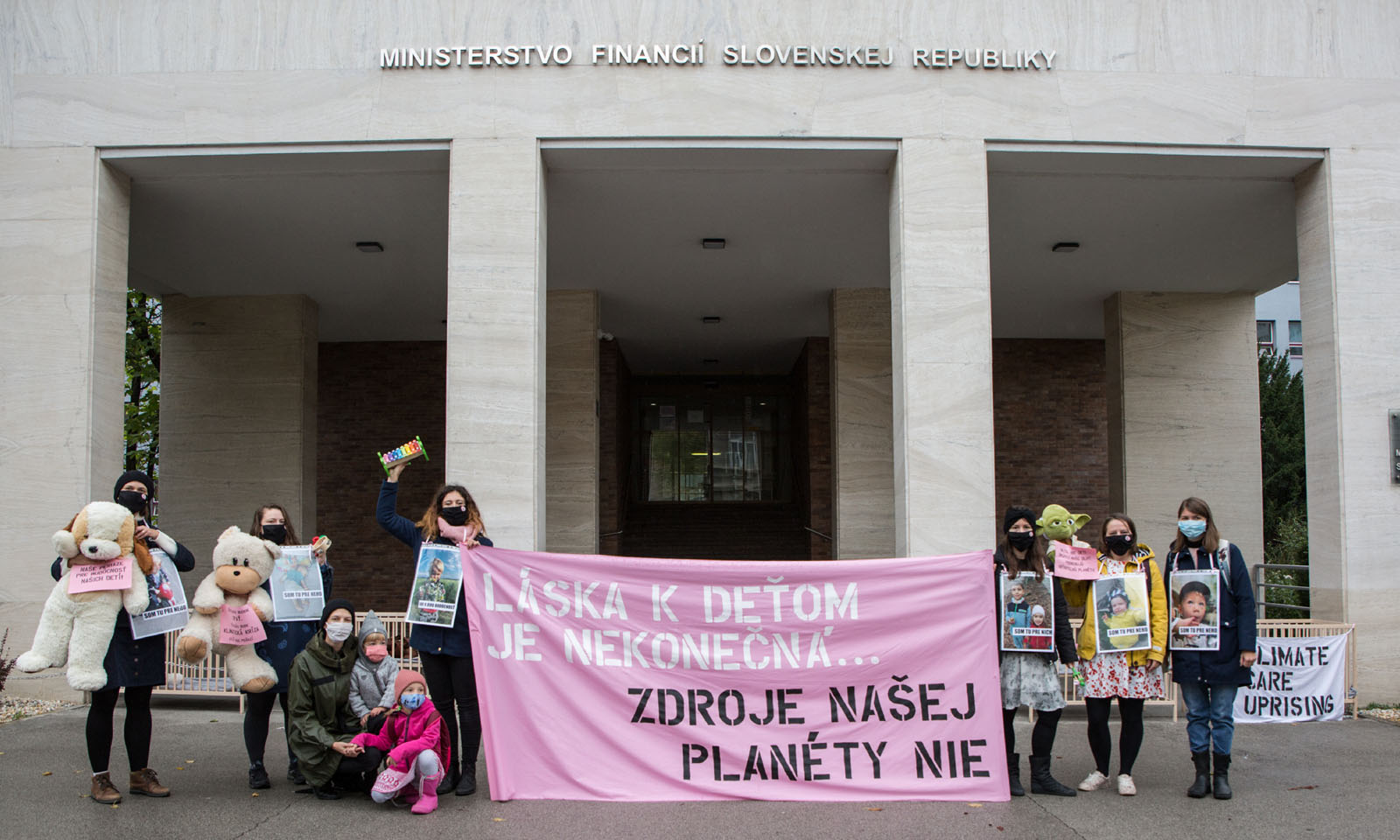
“I started out in the nineties as a leftist punk in Bratislava garages,” says Martina. “We were one pack. We went to demonstrations against fascism and racism, in support of squatters, for a ban on Freon. I was a pissed-off feminist, and I told capitalism to go to hell. Now I’m a mother of three daughters, leading a fight to save the planet, the climate, and biodiversity. Our children need us to act.”
“I got into the climate issue around 2013, through my involvement in environmental organizations and movements like Duha,” says Josef. “For me, the turning point was the international climate summit in Istanbul called Global Power Shift. Hundreds of young climate activists from all over the world gathered there. Around that time I also saw Al Gore’s film An Inconvenient Truth. It shook me. I couldn’t understand how this was happening. That we as humanity had let it happen. And that nobody wanted to do anything about it. I wanted to bring this issue to the Czech Republic.”
Martina Kedrová is a member and one of the visible faces of the movement Znepokojené matky (Concerned Mothers), currently one of the most prominent Slovak climate movements that brings together women and mothers working to address the climate crisis, air pollution, and biodiversity loss. Josef Patočka is a founding member of the movement Limity jsme my (We Are the Limits) that emerged in 2015 in response to efforts to lift the limits on brown coal mining in northern Bohemia. The movement drew attention with a campaign to end coal mining and its Climate Camps – nonviolent blockades of coal mines, and with. This contributed significantly to the climate debate in the Czech Republic and accelerated pressure to move away from this fossil fuel.
Don’t Look Down
Martina and Josef are among the thousands of determined and engaged people sensitive to the climate crisis who are active in climate movements. The global wave of these movements grew in 2019 and then again after the pandemic ended. It began with Greta Thunberg’s school strike in August 2018 which quickly mobilized millions of students around the world and led to the creation of Fridays for Future. On September 20, 2019, Greta Thunberg stood at the head of the global climate strike, and three days later she delivered her rousing How Dare You speech at the UN. In the same year, the British movement Extinction Rebellion spread internationally, protesting political leaders’ inaction on the climate crisis and the collapse of biodiversity. In April 2019, its members organized an eleven-day occupation of key traffic hubs in London. The action led to more than a thousand arrests yet it forced the British Parliament to declare a climate emergency.
The narrative of a climate emergency and crisis, along with tactics of civil disobedience and public provocation, shaped the activities of climate movements after the pandemic. Members of Just Stop Oil, a British activist coalition that relies on civil disobedience and provocative vandalism to stop the extraction of fossil fuels, threw Heinz tomato soup at Van Gogh’s painting Sunflowers in the National Gallery in London in October 2022. In May 2023, Italian members of the movement Last Generation entered Rome’s Trevi Fountain and poured liquid charcoal into the water. The black water was meant to symbolize the destructive impact of fossil fuels. Probably the most controversial tactic of civil disobedience, however, became the systematic blockades of roads and other transport infrastructure by the movement Last Generation in Germany. Between 2022 and 2024, the movement managed to organize hundreds of blockades, carried out with the drastic method of gluing their hands to the road. In June 2023, they completely blocked Berlin’s central traffic artery, Straße des 17. Juni connecting the Brandenburg Gate with the Victory Column.
The tactics of vandalism, infrastructure blockades, and disruption of public life on which other activist organizations and movements have also relied (for example, the German movement Ende Gelände which inspired the Czech movement Limity jsme my, or the American movement Declare Emergency), grow in all these movements out of legitimate demands to address the climate crisis quickly and decisively. These demands include: abide by international agreements, quickly reduce emissions, end subsidies for the fossil fuel industry, introduce a moratorium on new fossil fuel extraction projects, accelerate the transition to renewable energy, introduce affordable public transportation, inform the public transparently about the climate and ecological emergency, and enable the creation of citizens’ assemblies that would take part in planning the ecological transformation and in discussing a climate-just future.
These demands are consistent not only with the conclusions and recommendations of climate science but also with the legal and political commitments of European countries. The binding Paris Agreement sets the goal of holding global warming well below 2°C and pursuing efforts to limit it to 1.5°C compared with the preindustrial period. According to the IPCC, limiting warming to 2°C requires rapid, dramatic, and sustained reductions in greenhouse gas emissions in all sectors of the economy: by 21 percent by 2030 and by 64 percent by 2050 compared with 2019 levels, and reaching carbon neutrality around 2050. At the same time, it is essential to quickly end dependence on fossil fuels and transform energy systems toward renewable sources. In the EU, the commitment to achieve climate neutrality by 2050 and to cut emissions by at least 55 percent by 2030 is enshrined in the European Climate Law. The German Federal Constitutional Court confirmed these goals and also explicitly linked them to the protection of the fundamental rights and freedoms of individuals and future generations.
“That’s what this is about,” Martina explains. “It’s not some abstract, self-serving fight against the system by foolish, crazy people. It’s a fight for a world in which our children have access to water and food and live in safety. I can’t keep my mouth shut and just cook or plant little trees. We need to put pressure on the system, on politicians. To say that we’re afraid for our children and to force them to do something about it. And to fight for concrete things: the adoption of a climate law, against a new toxic incinerator, for measures against heat in cities, for better and more accessible public transportation.”
How the Movement Became a Bad Story
The wave of climate movements has ebbed. Some movements have disappeared, dissolved, or changed tactics. A typical example is Last Generation which provoked an unprecedented level of resistance and aggression in Germany and de facto ceased to exist at the end of 2024. Its members faced unprecedented physical and verbal violence from drivers and the public during protests, as well as police repression, raids, and the kind of force that is usually applied to perpetrators of serious crimes. Media, authorities, and courts systematically labeled them with terms such as criminality, extremism, and even terrorism. Some politicians even compared Last Generation to the far-left terrorist group the RAF. The courts then interpreted their blockades as unlawful criminal coercion, vandalism, destruction of property, and sabotage, and punished the activists with prison sentences and heavy fines.
The breakup of Last Generation represents all the strategies of public and political resistance to climate movements that are available: political delegitimization, criminalization through police violence and court proceedings and heavy sentences, and media portrayal of the movement as an enemy of major social groups, such as workers, farmers, and employees in transportation and industry. And, of course, the total discrediting and ridiculing of activists, aimed at calling their seriousness into question and pushing them out of public space together with the climate goals they pursue. The resistance to young activists in the Czech Republic was recently described by the sociologist Lenka Vochocová in an interview with Deník N. She spoke about how young activists are dismissed as puppets manipulated by adults, liberals, and leftists, as “spoiled elites detached from reality” or “kids who should be allowed to be kids” – and how they are often advised not to ride in their father’s SUV, not to fly to Barcelona, and to finish their studies before they comment on anything.
The denigration, insults, and questioning directed at climate activists are deeply unjust. They target people who devote their time, energy, and often their personal safety to defending a future that concerns all of us. Climate activists are exposed to police violence, prosecution, and financial penalties, and they bear considerable personal and economic costs for their activities. They act out of a sense of responsibility and a conviction that the political response to the climate crisis is dangerously inadequate and that someone has to act. Activists are doing the work of advancing the climate agenda that political institutions, governments, and society as a whole have failed to do. Their actions can be understood not only as a form of legitimate civil disobedience but above all as a form of moral courage: taking on an important social task and accepting considerable personal costs and sacrifices for the benefit of everyone. Instead of demonization and criminalization, which only increase the acceptability of violence against protest movements, we should first focus on the convictions that lead climate activists to expose themselves to such high risk.
Portraying them as extremists, hooligans, provocateurs, lunatics, or a threat to society, while ignoring the urgency of the crisis they are trying to address, is wrong. And of course also insulting. “Nobody would dare to physically attack a mother with a child,” says Martina. “But you know what’s terrible? Body shaming, for example, gender stereotypes, or sexualization. You’re shortly after giving birth, you weigh ninety kilos, your breasts look like something out of a porn film, you have circles under your eyes. You’re not sleeping, you’re taking care of a baby, and at the same time you’re trying to be civically engaged. And then on social media people write under your photos from the demonstration that you’d best save the climate by not stuffing your face so much. Or, when you criticize injustice in transportation, they write that they have a big car and will give you a ride, if your husband allows it. It’s disgusting. It’s not an argument. You can’t defend yourself against it or discuss it. It hurts.”
A Failure of Democracy?
Is the decline of climate movements a problem for democracy? Does it mean a transformation or even a decline of democracy? Social movements, including those that use tactics of civil disobedience and disruption of public order, play an essential role in democracy. Above all, they open up space for participation for issues that have so far been marginalized, for excluded groups and for their sense of injustice. They represent a legitimate and important way of putting a new agenda into public space. In this way, they strengthen the robustness and resilience of democracy as a system capable of adapting to new conditions.
Climate protests are also a reaction to the fact that democracy is not sufficiently prepared to deal with a problem as global, complex, and urgent as climate change. Robin Celikates, an expert on social movements, speaks in this context of a multidimensional failure of democracy. On the one hand, this flaw concerns the insufficient representation of young people and their limited opportunities for full participation in politics, as well as the lack of attention to issues that directly affect them. It is caused by the voting age being too high, by political parties paying insufficient attention to generation-specific problems, and by politics’ notorious inability to look further into the future and take the interests of future generations into account. Then there is a problem that Celikates calls “epistemic failure”. It arises because public communication, the media, the agenda-setting of political parties, and parliamentary decision-making processes are unable to work with scientific findings and expert knowledge, especially not with complex climate science.
Climate movements politicize the global problem of climate change and give it concrete contours of social justice and desirable policies in their domestic public spheres and national democracies. The movement Limity jsme my began as a movement to defend the village of Horný Jiřetín against the breaching of coal mining limits. It built on the local residents’ resistance and their legitimate sense of injustice which arose from the threat of the destruction of their homes, forced relocation, further deterioration of air quality, noise, dust, and the overall degradation of the landscape and regional infrastructure, as well as from the health impacts of expanded coal mining on residents. The movement linked the protection of northern Bohemian villages with the goal of stopping coal mining and thereby contributing to the global goal of halting advancing climate change. The mobilization in support of local residents was at the same time a mobilization of the Czech public and politicians to support the end of coal and thus contribute in a fundamental way to solving the climate crisis.
What Next?
“I don’t know what fate awaits climate protest and politics,” says Josef skeptically. “Resistance to climate movements and repression have gotten terribly worse. The fossil fuel oligarchy in the Czech Republic has also begun to push its interests much more aggressively: taking over political positions, controlling the media and public discussion, financing political parties. Another problem is the end of the international liberal order and its norms of global justice. And really the end of liberal democracy as such. The climate movement wanted to create a driving force for a system that was expected to fulfill its own goals, values, and laws. Today the movements have no chance of reaching the interests of the majority. Liberal democracy is gone. It is being replaced by the fascist right which refuses to address climate change and slips into the role of defender of ordinary people and their material needs. It has convinced them that climate policy threatens the prices of food, gasoline, housing, and so on. And that is ultimately the problem of neoliberal climate policy: it does not target the rich, the fossil oligarchy, or luxury consumption, but demands sacrifices from ordinary people. The only way I see is a dramatic change in the economy and in the production of goods such as food and energy, so that people, in meeting their basic needs, do not take part in ecological destruction.”
Martina also speaks of the threat to liberal democracy. “In Slovakia, too, we talk about the extent to which democracy still exists there. It’s as if we were already playing a completely different game. We’re being steamrolled by topics like war, the terror of the digital world, and artificial intelligence,” she adds. “Nevertheless, it is essential for us not to let them steal the topics that concern everyone and especially our children: drought, pollution, open and safe public space, the destruction of nature. We want to – we must, really – keep explaining to people what the climate crisis is and that its impacts are concrete: that in the summer you have no water, you can’t go outside during the day, it’s hot in the hospital, and so on. So I and the other Concerned Mothers will keep alerting people and explaining to them, online and in person, that we don’t want to scratch anyone’s car or take away disposable diapers, but that we need to move to renewable energy and a sustainable economy. We want to keep these small spaces of communication and awareness-raising. For us, they are also bubbles of human belonging, solidarity, kindness, and care. That is really also a remedy for climate anxiety for me. Being kind and persuading people that we have to fight for a just future for everyone still makes sense to me.”

The text was produced with the support of the Friedrich Ebert Stiftung, Representation in the Slovak Republic.